
- This event has passed.
LIFE IS ART IS MOTHERHOOD IS ART — KYOTO
[et_pb_section fb_built=”1″ custom_padding_last_edited=”off|desktop” admin_label=”Header” _builder_version=”4.16″ background_color_gradient_direction=”188deg” background_image=”https://crsny.org/wp-content/uploads/2025/12/art-gallery-55.jpg” background_size=”initial” background_repeat=”repeat” width=”100%” custom_padding_tablet=”5vw||5vw||true” global_colors_info=”{}”][et_pb_row _builder_version=”4.27.5″ _module_preset=”default” global_colors_info=”{}”][et_pb_column type=”4_4″ _builder_version=”4.27.5″ _module_preset=”default” global_colors_info=”{}”][et_pb_text _builder_version=”4.27.6″ text_font=”||||||||” header_font=”|700|||||||” header_font_size=”20px” header_line_height=”1.3em” header_2_font=”|700|||||||” header_2_font_size=”20px” header_2_line_height=”1.3em” header_3_font=”|700|||||||” header_3_font_size=”16px” header_3_line_height=”1.3em” header_font_size_tablet=”” header_font_size_phone=”” header_font_size_last_edited=”on|desktop” locked=”off” global_colors_info=”{}”]
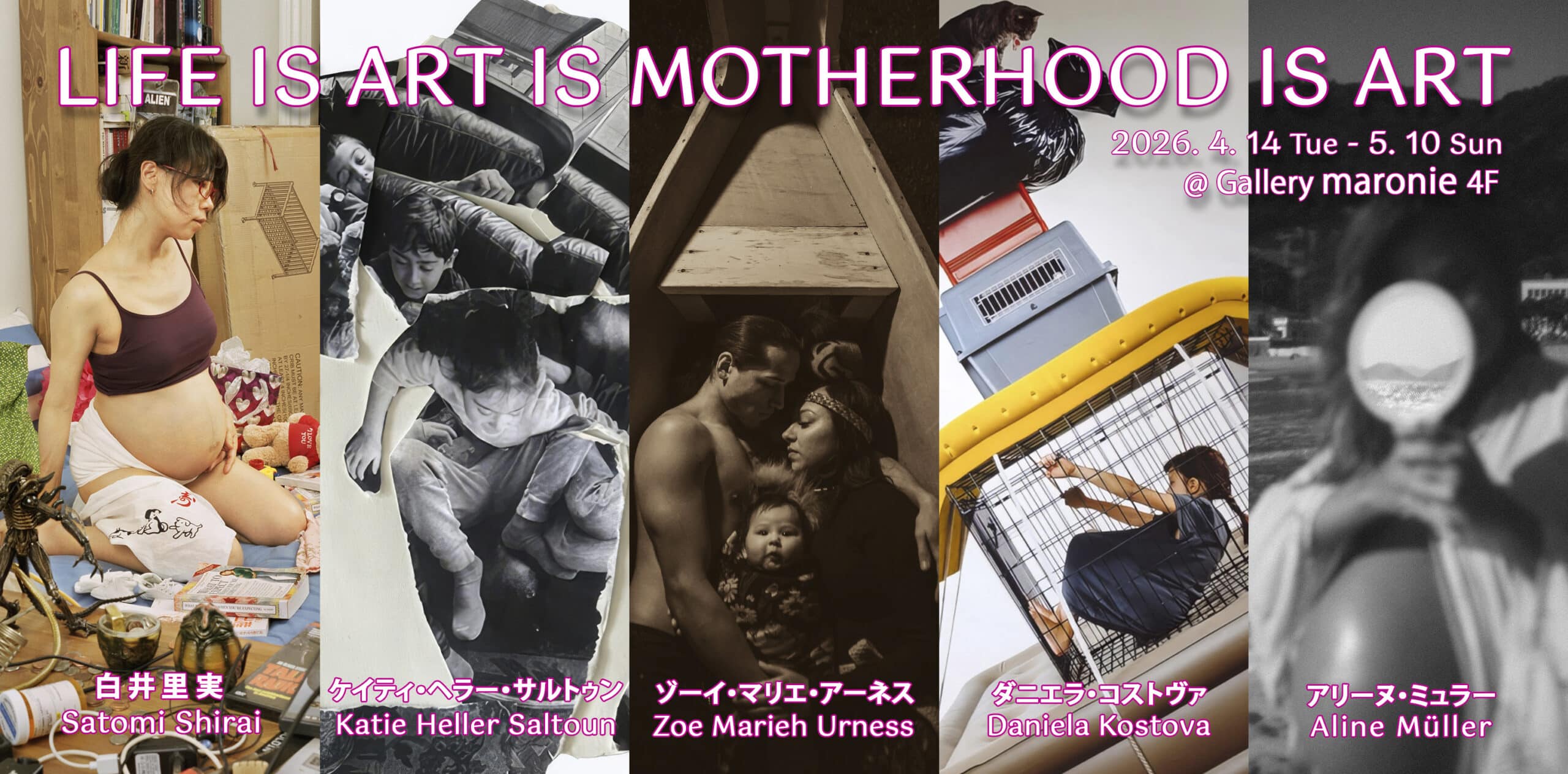
 Life Is Art Is Motherhood Is Art features photographs by five artists who are mothers: Daniela Kostova (Bulgaria), Aline Müller (Brazil), Katie Heller Saltoun (USA), Satomi Shirai 白井里実 (Japan), and Zoe Marieh Urness (Alaskan Tlingit and Cherokee). Across diverse geographies and experiences, their works explore motherhood as a potent generative force connecting family life to culture, environment, memory, and collective responsibility.
The exhibition, a version of which debuted at Tenri Cultural Center of New York in July 2025, will be on view at Gallery Maronie in Kyoto, Japan, as a featured exhibition of Kyotographie KG+ from April 14 to May 10, 2026, before moving to Le Déco Gallery in Tokyo from May 19 to May 24, 2026. Opening hours at Gallery Maronie are Tu – Sa from 12 – 7 pm and Su 12 – 6 pm.
A Closing Reception and Artist Talk will be held on May 10 from 3 – 5 pm in the 4th FL gallery of Gallerie Maronie. Exhibition artists Daniela Kostova and Satomi Shirai and curator Christopher Pelham will discuss the exhibition’s core themes with moderator Sae Shimai-Cardonnel, director of MOMENT Contemporary Art Center and former co-director of KG+. The talk will be conducted in English with consecutive interpretation into Japanese by Miho Tsujii.
“KG+” is a public art festival founded in 2013 with the aim of discovering and supporting upcoming photographers and curators. In cooperation with “KYOTOGRAPHIE Kyoto International Photography Festival,” KG+ gives upcoming photographers and curators participating in KG+ opportunities to talk and collaborate with world-renowned curators and gallerists from Japan and around the world.
X @kgplus_kyoto
Instagram @kgplus
Facebook @KGplusevent
[/et_pb_text][/et_pb_column][/et_pb_row][/et_pb_section][et_pb_section fb_built=”1″ admin_label=”Gallery” _builder_version=”4.16″ background_image=”https://crsny.org/wp-content/uploads/2025/12/art-gallery-55.jpg” background_size=”initial” background_repeat=”repeat” global_colors_info=”{}”][et_pb_row custom_padding_last_edited=”off|phone” _builder_version=”4.16″ background_position=”bottom_center” custom_padding_tablet=”17vw||17vw||false” use_custom_width=”on” width_unit=”off” custom_width_percent=”100%” locked=”off” global_colors_info=”{}”][et_pb_column type=”4_4″ _builder_version=”4.16″ custom_padding=”|||” global_colors_info=”{}” custom_padding__hover=”|||”][et_pb_text _builder_version=”4.27.5″ text_font=”||||||||” header_font=”||||||||” header_2_font=”Prata|500|||||||” header_2_text_align=”center” header_2_font_size=”56px” header_2_line_height=”1.3em” header_3_font=”|700||on|||||” header_3_text_align=”center” header_3_text_color=”rgba(0,0,0,0.35)” header_3_font_size=”12px” header_3_letter_spacing=”5px” header_3_line_height=”2em” transform_translate_linked=”off” max_width=”700px” max_width_tablet=”70%” max_width_last_edited=”off|phone” module_alignment=”center” header_2_font_size_tablet=”40px” header_2_font_size_phone=”26px” header_2_font_size_last_edited=”on|phone” header_3_font_size_phone=”10px” header_3_font_size_last_edited=”off|desktop” module_alignment_last_edited=”off|desktop” global_colors_info=”{}”]
Exhibition Preview
[/et_pb_text][/et_pb_column][/et_pb_row][et_pb_row column_structure=”1_5,1_5,1_5,1_5,1_5″ _builder_version=”4.16″ global_colors_info=”{}”][et_pb_column type=”1_5″ _builder_version=”4.16″ custom_padding=”|||” global_colors_info=”{}” custom_padding__hover=”|||”][et_pb_image src=”https://crsny.org/wp-content/uploads/2025/12/19_Satomi-Shirai_Pregnancy_©Satomi-Shirai-series-title-scaled.jpg” alt=”Pregnancy © by Satomi Shirai” title_text=”Pregnancy © by Satomi Shirai” show_in_lightbox=”on” align=”center” admin_label=”Pregnancy © by Satomi Shirai” _builder_version=”4.27.5″ global_colors_info=”{}”][/et_pb_image][et_pb_text _builder_version=”4.27.5″ _module_preset=”default” global_colors_info=”{}”]
Pregnancy © by Satomi Shirai
[/et_pb_text][/et_pb_column][et_pb_column type=”1_5″ _builder_version=”4.16″ custom_padding=”|||” global_colors_info=”{}” custom_padding__hover=”|||”][et_pb_image src=”https://crsny.org/wp-content/uploads/2025/12/10_Daniela-Kostova_Scrap-Opera-3_©Daniela-Kostova-Scrap-Opera-scaled.jpg” alt=”Scrap Opera 3 © by Daniela Kostova” title_text=”Scrap Opera 3 © by Daniela Kostova” show_in_lightbox=”on” align=”center” admin_label=”Scrap Opera 3 © by Daniela Kostova” _builder_version=”4.27.5″ global_colors_info=”{}”][/et_pb_image][et_pb_text _builder_version=”4.27.5″ _module_preset=”default” global_colors_info=”{}”]
Scrap Opera 3 © by Daniela Kostova
[/et_pb_text][/et_pb_column][et_pb_column type=”1_5″ _builder_version=”4.16″ custom_padding=”|||” global_colors_info=”{}” custom_padding__hover=”|||”][et_pb_image src=”https://crsny.org/wp-content/uploads/2025/12/1_Zoe-Urness_-Mariana-Yakama-Nation_@Zoe-Urness-Indigenous-Motherhood-scaled.jpg” alt=”Mariana (Yakama Nation) © by Zoe Urness” title_text=”Mariana (Yakama Nation) © by Zoe Urness” show_in_lightbox=”on” align=”center” admin_label=”Mariana (Yakama Nation) © by Zoe Urness” _builder_version=”4.27.5″ global_colors_info=”{}”][/et_pb_image][et_pb_text _builder_version=”4.27.5″ _module_preset=”default” global_colors_info=”{}”]
Mariana (Yakama Nation) © by Zoe Urness
[/et_pb_text][/et_pb_column][et_pb_column type=”1_5″ _builder_version=”4.16″ custom_padding=”|||” global_colors_info=”{}” custom_padding__hover=”|||”][et_pb_image src=”https://crsny.org/wp-content/uploads/2025/12/Copy-of-DSCF6524-scaled.jpg” alt=”Untitled © by Aline Müller” title_text=”Untitled © by Aline Müller” show_in_lightbox=”on” align=”center” admin_label=”Untitled © by Aline Müller” _builder_version=”4.27.5″ locked=”off” global_colors_info=”{}”][/et_pb_image][et_pb_text _builder_version=”4.27.5″ _module_preset=”default” global_colors_info=”{}”]
Untitled © by Aline Müller
[/et_pb_text][/et_pb_column][et_pb_column type=”1_5″ _builder_version=”4.16″ custom_padding=”|||” global_colors_info=”{}” custom_padding__hover=”|||”][et_pb_image src=”https://crsny.org/wp-content/uploads/2025/12/13_Katie-Heller-Saltoun_Cramped_@Katie-Heller-Saltoun-series-title-scaled.jpg” alt=”Cramped © by Katie Heller Saltoun” title_text=”Cramped © by Katie Heller Saltoun” show_in_lightbox=”on” align=”center” admin_label=”Cramped © by Katie Heller Saltoun” _builder_version=”4.27.5″ locked=”off” global_colors_info=”{}”][/et_pb_image][et_pb_text _builder_version=”4.27.5″ _module_preset=”default” global_colors_info=”{}”]
Cramped © by Katie Heller Saltoun
[/et_pb_text][/et_pb_column][/et_pb_row][/et_pb_section][et_pb_section fb_built=”1″ admin_label=”Description” _builder_version=”4.27.5″ _module_preset=”default” global_colors_info=”{}”][et_pb_row admin_label=”Description” _builder_version=”4.27.5″ _module_preset=”default” global_colors_info=”{}”][et_pb_column type=”4_4″ _builder_version=”4.27.5″ _module_preset=”default” global_colors_info=”{}”][et_pb_text _builder_version=”4.27.5″ _module_preset=”default” global_colors_info=”{}”]
In dialogue with Kyotographie 2026’s theme, EDGE, the exhibition approaches motherhood as a lived threshold: a condition situated between self and other, private and public, care and survival, inheritance and change. The works center care as both subject and methodology. Like photography — poised between documentation and interpretation — motherhood demands attention, responsiveness to change, and openness to uncertainty. These qualities shape how the artists frame images, work with time, and attend to what is fragile, unfinished, or overlooked. Domestic interiors, caregiving, Indigenous communities, bodies in transformation, and rituals become sites of critical knowledge, where social systems, ecological precarity, and cultural memory are engaged with urgency.
Several works extend practices of nurturing beyond the family unit. Zoe Urness honors Indigenous traditions, documenting Native American life, cultural continuity, and resistance, showing care — for land, community, and history — as inseparable from justice. Daniela Kostova stages family life amid decay, disaster, and improvisation, using domestic roles as rehearsals for survival within unstable ecological and social systems.
Other photographs explore the edges of identity, home, and becoming. Satomi Shirai works between cultures and generations, examining home as an intangible, shifting space where identity remains unresolved. Katie Heller Saltoun inhabits the domestic interior as a charged threshold between confinement and creation, honoring the labor, repetition, and emotional charge of everyday care through raw, layered processes. Aline Müller mines the liminal space of motherhood as a state of transformation — psychic, bodily, and ancestral — embracing fragmentation, tenderness, and the unresolved “in-between.”
Life Is Art Is Motherhood Is Art proposes motherhood as a creative frontier — where art, ethics, and responsibility intersect. At this edge, attentiveness and interdependence emerge not as obstacles to creativity but as vital tools for imagining new ways of living, creating, and coexisting in an uncertain world.
[/et_pb_text][/et_pb_column][/et_pb_row][/et_pb_section][et_pb_section fb_built=”1″ admin_label=”Footer” _builder_version=”4.16″ background_size=”initial” background_repeat=”repeat-y” custom_padding=”0px|||||” saved_tabs=”all” locked=”off” global_colors_info=”{}”][et_pb_row column_structure=”1_3,1_3,1_3″ use_custom_gutter=”on” gutter_width=”2″ _builder_version=”4.16″ border_width_top=”2px” global_colors_info=”{}”][et_pb_column type=”1_3″ _builder_version=”4.16″ custom_padding=”|||” global_colors_info=”{}” custom_padding__hover=”|||”][et_pb_text admin_label=”ADDRESS” _builder_version=”4.27.5″ text_font=”||||||||” text_font_size=”12px” text_line_height=”2em” link_font=”||||on||||” link_text_color=”#666666″ header_font=”||||||||” header_text_align=”left” header_3_font=”|700||on|||||” header_3_font_size=”12px” header_3_letter_spacing=”5px” header_3_line_height=”1.8em” max_width_tablet=”70%” max_width_last_edited=”off|phone” header_3_font_size_tablet=”” header_3_font_size_phone=”” header_3_font_size_last_edited=”on|desktop” locked=”off” global_colors_info=”{}”]
Address
Gallery Maronie
中京区河原町通四条上る塩屋町332
Kyoto City, Kyoto 604-8027
Japan + Google Map
Phone 075-221-0117
[/et_pb_text][/et_pb_column][et_pb_column type=”1_3″ _builder_version=”4.16″ custom_padding=”|||” global_colors_info=”{}” custom_padding__hover=”|||”][et_pb_text admin_label=”OPEN HOURS” _builder_version=”4.27.5″ text_font=”||||||||” text_font_size=”12px” text_line_height=”2em” link_font=”||||on||||” link_text_color=”#666666″ header_font=”||||||||” header_text_align=”left” header_3_font=”|700||on|||||” header_3_font_size=”12px” header_3_letter_spacing=”5px” header_3_line_height=”1.8em” max_width_tablet=”70%” max_width_last_edited=”off|phone” header_3_font_size_tablet=”” header_3_font_size_phone=”” header_3_font_size_last_edited=”on|desktop” locked=”off” global_colors_info=”{}”]
Open Hours
Monday: Closed
Tuesday – Saturday: 12 – 7 pm
Sunday: 12 – 6 pm
[/et_pb_text][/et_pb_column][et_pb_column type=”1_3″ _builder_version=”4.16″ custom_padding=”|||” global_colors_info=”{}” custom_padding__hover=”|||”][et_pb_text admin_label=”SOCIAL MEDIA FOLLOW” _builder_version=”4.27.5″ text_font=”||||||||” text_font_size=”12px” text_line_height=”2em” link_font=”||||on||||” link_text_color=”#666666″ header_font=”||||||||” header_text_align=”left” header_2_font=”||||||||” header_3_font=”|700||on|||||” header_3_font_size=”12px” header_3_letter_spacing=”5px” header_3_line_height=”1.8em” max_width_tablet=”70%” max_width_last_edited=”off|phone” header_3_font_size_tablet=”” header_3_font_size_phone=”” header_3_font_size_last_edited=”on|desktop” locked=”off” global_colors_info=”{}”]
Follow
[/et_pb_text][et_pb_social_media_follow _builder_version=”4.27.5″ custom_margin=”-20px|||-10px” custom_margin_tablet=”” custom_margin_phone=”-20px||” custom_margin_last_edited=”on|desktop” filter_invert=”100%” locked=”off” global_colors_info=”{}” icon_color__hover=”#e02b20″][et_pb_social_media_follow_network social_network=”facebook” url=”https://www.facebook.com/GalleryMaronie” _builder_version=”4.27.5″ global_colors_info=”{}” follow_button=”off” url_new_window=”on”]facebook[/et_pb_social_media_follow_network][et_pb_social_media_follow_network social_network=”instagram” url=”https://www.instagram.com/gallerymaronie/” _builder_version=”4.27.5″ global_colors_info=”{}” follow_button=”off” url_new_window=”on”]instagram[/et_pb_social_media_follow_network][/et_pb_social_media_follow][et_pb_image src=”https://crsny.org/wp-content/uploads/2025/12/Gallery-Maronie-map.png” alt=”Gallery Maronie map” title_text=”Gallery Maronie map” _builder_version=”4.27.5″ _module_preset=”default” global_colors_info=”{}”][/et_pb_image][/et_pb_column][/et_pb_row][et_pb_row use_custom_gutter=”on” gutter_width=”2″ _builder_version=”4.16″ border_width_top=”2px” global_colors_info=”{}”][et_pb_column type=”4_4″ _builder_version=”4.16″ custom_padding=”|||” global_colors_info=”{}” custom_padding__hover=”|||”][et_pb_heading title=”Artist Profiles” _builder_version=”4.27.5″ _module_preset=”default” global_colors_info=”{}”][/et_pb_heading][et_pb_text _builder_version=”4.27.6″ _module_preset=”default” hover_enabled=”0″ global_colors_info=”{}” sticky_enabled=”0″]
ABOUT EXHIBITION CURATOR CHRISTOPHER PELHAM
Christopher Pelham is Director of CRS (Center for Remembering & Sharing), a healing and art organization based in New York City that he co-founded in 2004 with the writer and lecturer Yasuko Kasaki. His many curatorial projects have spanned visual art, film/video, music, dance, and theater. He has organized exhibitions and events with a diverse range of international artists, including photographers Mao Ishikawa, Tomoko Iki, Clouds Architecture Office, Annie Ling, Miori Inata, and Nobuyuki Kobayashi; painters/sculptors Lex Braes, Keiko Nelson, Christian De Boschnek, Mariko Mori, Yasuka.M, and Eric Holzman; dance by Yoshiko Chuma and the School of Hard Knocks, Jennifer Nugent, Alexandra Beller, Megumi Eda, Guido Tuveri, Rana Gorgani, and Yuko Kaseki; and music by Morio Agata, Jen Shyu, Scott Robinson, Elsa Nilsson, Val Jeanty, Yoon-ji Lee, Kaoru Watanabe, and gamin, among many others. His own photographs have appeared in publications such Downbeat, The Wire, and I Care If You Listen. His photography and recent writing on the arts can also be found on https://onlylove.art.
ABOUT DANIELA KOSTOVA
Daniela Kostova is an interdisciplinary artist whose work spans photography, installation, video, and performance. She explores themes of geography, cultural identity, and the complexities of translation and communication across borders. Her projects have been exhibited internationally at institutions including the Queens Museum of Art, Kunsthalle Wien, Centre d’Art Contemporain (Geneva), and Kunsthalle Fridericianum (Kassel), among others. In 2019, she created one of Europe’s largest public art installations, Future Dreaming, covering Vienna’s Ringturm building.
Kostova has received numerous awards and fellowships, including the Unlimited Award for Contemporary Bulgarian Art and residencies at A.I.R. Gallery (NYC), ZK/U Berlin, and ArtsLink at the Cleveland Institute of Art. She has also contributed as a curator, notably leading the BioArt Initiative at RPI, where she taught digital imaging. Her work has been featured in major publications such as The New York Times, Brooklyn Rail, and Art in America. Now based in New York City, she has served as Director of Curatorial Projects at Radiator Gallery, Artist Mentor at NYFA’s Immigrant Artist Program and Board Member of CEC Artslink.
DANIELA KOSTOVA ARTIST STATEMENT
My practice often begins within my immediate environment, using my family as both collaborators and protagonists to explore broader social, political, and ecological conditions.
In Scrap Opera (2011), a series of photographs staged in a ruined Victorian mansion, domestic life becomes an operatic performance set against decay. A pregnant woman with horns, a masked man in a stained robe, and a table laid with chicken bones evoke a pagan, pre-apocalyptic atmosphere. The work blends fantasy and necessity, asking whether these figures are freely inhabiting an alternative way of life or merely surviving within the remnants of another. Pregnancy here marks both creation and exposure, positioning the family unit as a fragile yet defiant structure within a collapsing environment.
This focus on care and role-making continues in New Role Models (2015), a photograph featuring my daughter and her babysitter, Rain Dove. Moving between the domestic sphere and the glamorous world of fashion, the androgynous caregiver embodies a fluid negotiation of gender, labor, and visibility. The work examines childcare as a socially coded space and frames role-shifting as a strategy for navigating normative systems, with parenthood becoming a lens through which social tolerance, economic survival, and identity performance are reconsidered.
In Stuck (2017), my daughter reappears, this time enclosed within a cage atop an inflatable mattress – a reference drawn from online images documenting natural disasters in the United States. These images of improvised escape vehicles, loaded with children, pets, and household objects, collapse the distinction between leisure and survival. Sourcing the materials from my own home, I translate distant catastrophe into an intimate scenario. The work reflects on climate precocity and the unsettling realization that domestic safety can abruptly transform into confinement, turning play into a condition of emergency.
Together, these works trace a trajectory in which family life becomes a site for rehearsing survival, care, and adaptation – revealing how personal roles are entangled with larger systems of collapse, resilience, and change.
ABOUT ALINE MÜLLER
Photographer Aline Müller, born in the Brazilian Amazon and now working between Rio and New York, brings an elemental understanding of nature’s power to her intimate portraits of women. In her series curated for Life is Art Motherhood is Art, she captures mothers at different stages of their journey through evocative, almost surreal photographs that reveal the mystical within the everyday of motherhood.
Müller’s mothers emerge water-soaked from rivers, beaches, and showers with goddess-like splendor. They inhabit moments of joyous presence captured in delicate close-ups that refuse to hide or pose, but rather document dreamlike moments of maternal reality. With her generous and almost metaphysical gaze, Aline has the uncanny ability to depict what photography often editorializes out of women’s lives: fluids, curves, small gestures, and all that seems small and menial in life, yet speaks volumes to the internal world of women.
ALINE MÜLLER ARTIST STATEMENT
In Circle, Aline Müller composes a non-linear narrative of motherhood, using photography as a space for emotional, symbolic, and somatic inquiry. The circle present in the physical arrangement of the works and in the metaphors that run through them is not just a shape, but a way of thinking — a cycle of birth and disappearance, inheritance and rupture, love and disorientation.
Her images reject sentimental or glorified representations of maternity. Instead, they open space for what is raw, fragmented, and complex. Mirrors, bodies, water, shadows — elements that repeat and echo throughout the series — speak of reflection, but also of the difficulty of self-recognition in the wake of becoming a mother. The transformation is not only physical; it is psychic, ancestral, and at times, destabilizing.
Some of the photographs are intimate and tactile — close enough to feel skin, milk, or breath. Others are more distant, invoking a kind of absence: the mother as a trace, a silhouette, a blurred presence. Through these gestures, Müller touches on a deep tension, the near-invisibility of the mother as subject in her own story.
Made over time, between personal commissions and private moments, these images emerge from cycles of anxiety, reinvention, and deep emotional exposure. Müller doesn’t seek resolution; she invites us into the in-between. Her visual language, elliptical and tender, mirrors the state of living between worlds: between who we were and whom we become, between what we inherit and what we choose to break.
Circle is not a document. It is a gesture — one of return, of witnessing, of drawing a line around the ineffable, and holding it with care.
ABOUT KATIE HELLER SALTOUN
Katie Heller Saltoun is a visual artist based in DUMBO, Brooklyn, New York. Her work primarily utilizes oil paint, ink, photographic collages, and woodcut printing to explore the multifaceted experiences of motherhood and caregiving. Saltoun captures the humor, frustration, monotony, and profound love inherent in caregiving, drawing inspiration from her own life and the diverse narratives of mothers and caretakers she encounters. Her compositions often depict dynamic scenes of energy and chaos, as well as repetitive imagery such as refrigerator shelves, spice racks, and rows of snacks, reflecting the repetitive yet vital tasks of domestic life.
Saltoun holds a BFA from the University of Michigan, an MA from Columbia University, and an MFA from Pratt Institute. Her recent exhibition, “Bifocal: Motherhood and Creativity,” was held at the Elza Kayal Gallery in Tribeca, New York. This multidisciplinary show explored the intricate interplay between creativity and motherhood, highlighting the often-overlooked experiences of artists who navigate both roles. Additionally, her work was featured in The American Scholar magazine in an article titled “Tenderness and Grit.”
Saltoun continues to create and exhibit work that resonates with audiences, offering a profound and authentic portrayal of the complexities inherent in caregiving and domestic life.
KATIE HELLER SALTOUN ARTIST STATEMENT
My work explores the daily rituals, chaos, humor, repetition, and frustrations that come with being a mother inside the home. As a mother, I am constantly flooded with a tidal wave of emotion: frustration, anger, exhaustion, empathy, and deep love. The domestic space, for me, is a site of both confinement and creativity. It’s where the demands of caregiving collide with moments of deep reflection, observation, and making. Within this space, I find a strange intimacy and tension that fuels my work. By exploring the familiar, I aim to honor the labor embedded in daily domestic life. I draw inspiration from other artist-mothers who courageously share their personal narratives, stories that validate and strengthen all who perform this often invisible labor. In my practice, I work with a range of materials, including photographic collages, ink, printmaking, and oil paint. I often tear and staple large sheets of paper to the wall, embracing a raw physicality in my process. The range of media allows me to control the intensity through layers of color, texture, wash, and line, channeling the weight and frenetic energy of caregiving. My hope is that viewers recognize fragments of their own domestic experience within these altered scenes and connect through the shared nuances of daily life.
ABOUT SATOMI SHIRAI
Satomi Shirai playfully explores themes of cultural identity, feminism, motherhood, and the evolving meaning of home, both in the context of migration and as a universal psycho-spiritual experience. Her photographs, often set in domestic spaces, reveal the quiet tensions between order and chaos, belonging and estrangement, the visible and the unseen. Shirai’s work has been exhibited widely, including at the Tokyo Metropolitan Museum of Photography, the National Portrait Gallery in London, and the Smithsonian National Portrait Gallery in Washington, D.C. Her photographs are held in the collections of the Tokyo Metropolitan Museum of Photography and the Kiyosato Museum of Photographic Arts (K’MoPA).
After earning a Full-Time Certificate from the International Center of Photography in 2007 and an MFA from Hunter College (CUNY) in 2010, Shirai lived and worked in New York City for over a decade. In 2015, she returned to Japan to raise her daughter and now lives and works in Tokyo and Chiba Prefecture. Though she has exhibited less frequently since her return, she continues to create new work, often in collaboration with her daughter.
SATOMI SHIRAI ARTIST STATEMENT
I make photographs that explore themes of cultural identity, feminism, physical expression in everyday life, and the special connection between mother and child. Since becoming a mother, I’ve focused more on documenting lives in their natural surroundings—drawing inspiration from the intense energy of my child’s small, growing body, the beauty of her spontaneous movements, and the surprising and often funny ways she engages with the world.
“Walls with windows and doors form the house,
but the empty space within it is the essence of the house.”
—Lao Tzu, from “The Uses of Not” from Tao Te Ching
My work also reflects on what constitutes “home” — first as an immigrant in New York, and now, for the past decade, back in Japan. The tension between tangibility and intangibility continues to shape this inquiry: how do we define or recognize home?
In this exhibition, I am mixing elaborately staged earlier works from when I was pregnant and new to motherhood with more recent photos created in collaboration with my daughter. Images of the miniature dream houses my mother made, and my daughter often played with, are projected onto my daughter and onto the actual interior of our home. In the shifting environments and connections to the world, she appears in a state of yet-to-be-formed identity.
Through the process of making these works, I try to capture our evolving relationship and her evolving relationship to her home and the world. Rather than trying to convey fixed feelings or messages, I try to express the shifting, complicated, sometimes conflicting nature of intimacy, identity, and belonging, leaving the works open to multiple interpretations.
ABOUT ZOE MARIEH URNESS
Zoe Urness is a Tlingit photographer raised in the Pacific Northwest. She earned a Bachelor of Arts in Commercial Photography from the Brooks Institute of Photography in 2008. Urness lives and works between Santa Fe, New Mexico, and the Seattle area in Washington State.
Urness’s practice engages Indigenous representation, contemporary Native identity, and documentary storytelling. Early bodies of work confronted the legacy of Edward Curtis through staged, sepia-toned compositions that merge historical references with present-day Native sitters. In 2015, Urness documented the Standing Rock resistance on the Standing Rock Reservation in South Dakota, producing a significant body of documentary work from the movement.
Her photograph No Spiritual Surrender was nominated for a Pulitzer Prize in Feature Photography by World Literature Today and featured on the cover of its May 2017 issue. Urness is also the recipient of the 2022 Sony Alpha Female+ Grant in support of her project Indigenous Motherhood.
Urness’s work has been exhibited nationally and internationally, including at the Zimmerli Art Museum (2025), the Minneapolis Institute of Art (2019), the Autry Museum of the American West (2017–2018), and the Booth Western Art Museum (solo exhibition). Her work will be exhibited in the United Kingdom, Paris, and Tokyo in 2026.
ZOE MARIEH URNESS ARTIST STATEMENT
My art is a way for people to view modern Indigenous people photographed in traditional clothing and on land that is special to them. This imagery honors the past and shows how we are still here, living by traditions and values passed down from one generation to the next. Without honoring our traditional way of life and practices, we would not be here in this modern world. Art can serve as a platform to elevate Indigenous voices and perspectives, promote understanding, and celebrate Indigenous ways of life, both traditionally and contemporarily. It can also serve as a tool for cultural revitalization and preservation, highlighting the beauty and richness of Indigenous cultures and traditions.
This project has significant meaning to me because I am a mother. I gave birth to a baby girl, and the transformation I have experienced has been both physical and spiritual. This metamorphosis has spawned the inspiration for this photography project. The honor I have now for being female is felt deep in my soul and within my whole existence. I anticipate these images to be cinematic and to have a deep connection to Mother Earth, represented through varied landscapes.
I typically receive the ideas for my work through a series of vivid visions that come to me, sometimes through dreams, other times through sacred landscapes speaking to me. Once I recognize the vision, it’s as if all the pieces appear synchronistically, adding to the original vision, making it complete. As I evolve as an artist, I feel as if my entire body of work is braided together as one story being told through my lens.
Storytelling has been the way Native American cultures have been preserved for thousands of years, and they are used to teach and pass down values, history, and beliefs. Traditional storytelling has been shared through the spoken word, dance, song, and other art forms such as carvings, weaving, silversmithing, and drawings such as form line. I choose to use my camera as a tool to link the past and present through visual stories. As I was growing up, I learned the stories of my ancestors through my Tlingit elders, and through learning traditional clan songs and dance. Today, as a professional photographer and as an Indigenous woman and mother, I believe I have a unique perspective that has been formed by who I am and where I come from.
[/et_pb_text][/et_pb_column][/et_pb_row][/et_pb_section]